Does an Elevator Need a Dedicated Phone Line? ADA and ASME Requirements Explained
Key Takeaways
- Elevator code doesn’t demand one single, exclusive telephone line by name; it demands a communication path that stays open, gets answered, and is never blocked by other equipment.
- Copper landlines are being retired nationwide, so buildings still running elevator phones on old analog lines need a purpose-built cellular or supervised digital replacement, not a generic VoIP swap.
- Group One Safety & Security installs and monitors elevator phone lines built to satisfy these overlapping code layers, so building owners aren’t left interpreting technical language on their own.
If you manage a condominium, HOA, or commercial property in South Florida, you’ve probably gotten two different answers to the same question. One technician says your elevator needs its own dedicated phone line. Another says a shared line is fine. Both can be right, depending on what “dedicated” actually means under code, not on which wire happens to run into the machine room.
Group One Safety & Security helps keep elevator emergency phones across South Florida connected and compliant with ASME A17.1, the ADA, and Florida Building Code Chapter 30.
Below, we break down what the code actually requires, where the word “dedicated” gets misunderstood, and what changes when your building moves off a copper landline.
What Does “Dedicated” Actually Mean Under Elevator Code?
“Dedicated” isn’t a single, uniformly defined legal term that appears the same way in every code book. What ASME A17.1 and the ADA actually require is that the elevator’s emergency communication path is available the instant someone presses the call button; it can’t be busy, rerouted, or silently dropped because another device is using the same line.
In practice, that “always available” standard means:
- The call connects to a live person, not an automated system
- The line isn’t tied up by another device’s call in progress when the button is pressed
- The connection keeps working on battery backup during a power outage
- A visual signal confirms the connection so passengers who are deaf or hard of hearing know help is on the way
So “dedicated” is best read as a functional requirement (reserved for emergency use whenever it’s needed), not necessarily a mandate for one exclusive physical wire that touches nothing else in the building.
Not sure if your elevator line passes code? Group One sets up and monitors elevator emergency phones across South Florida to meet ASME A17.1, ADA, and Florida code. Explore Elevator Monitoring →
Does ASME A17.1 Require an Exclusive Phone Line?
ASME A17.1, the Safety Code for Elevators and Escalators, is the standard that governs elevator emergency communication across the country. It requires a two-way communication device, activated by a push button labeled “HELP,” that connects to authorized personnel around the clock. Handsets and closed compartments are prohibited, and a visual signal must confirm the call has gone through.
The code focuses on outcome, not wiring diagram. That’s why many elevator contractors and local specifications still call for “one dedicated outside telephone line” in project documents. It’s the simplest way to guarantee the line is never busy without adding extra hardware, but it’s a method of satisfying the availability requirement, not a separate rule stacked on top of it.
What Do the ADA and Florida Building Code Chapter 30 Add?
Where ASME A17.1 governs the communication itself, the ADA’s 2010 Standards for Accessible Design govern how accessible the phone has to be. Under Section 407 and the related U.S. Access Board guidance, the emergency device must:
- Sit no higher than 48 inches from the car floor
- Carry a tactile phone symbol and the word “HELP”
- Include a visual indicator light, not just an audible tone
- Work hands-free, with no handset required to communicate
Florida Building Code Chapter 30 adopts the applicable ASME elevator safety requirements, while accessibility requirements are addressed through the Florida Building Code’s accessibility provisions.
Can an Elevator Phone Share a Line With a Fax, Alarm, or Gate System?
Technically, yes, with the right hardware. Line-sharing devices exist that let an elevator phone seize priority over a shared line only for the seconds it needs to complete an emergency call. But in day-to-day practice across South Florida, most inspectors and elevator contractors want to see a line that the elevator call wins outright every time, since fire alarm communicators carry their own supervision requirements under NFPA 72 and shouldn’t be competing with the elevator phone for the same path during the same emergency.
Here’s where shared lines commonly fail at inspection:
- A busy signal because another device is mid-call when the button is pressed
- No callback path, so the monitoring center can’t ring back into the cab
- A fax machine or alarm dialer seizing the line during the exact emergency that trapped the passenger
- No test record proving the line is actually reserved when it’s checked
What Happens When Your Building’s Copper Line Gets Disconnected?
This isn’t a hypothetical. The FCC has been streamlining the retirement of copper telephone networks nationwide, and carriers are shifting customers onto fiber, wireless, and VoIP-based service on a faster timeline than in years past. Buildings still running elevator phones on old analog lines can lose that connection with little warning once their local wire center is retired.
The problem is that a generic, residential-grade VoIP swap often can’t deliver the steady signal, battery runtime, or line supervision an elevator phone panel is built to expect. The good news is that current editions of ASME A17.1 recognize cellular and digital paths as compliant alternatives, but only when backup power, supervision, and 24/7 monitoring are engineered into the replacement, not just swapped in as “internet phone service” and left untested.
Still running your elevator phone on copper? Our licensed Stuart technicians can move it to a supervised cellular path with battery backup and 24/7 UL-listed monitoring. Check My Elevator Line →
What Happens If Your Elevator Phone Line Isn’t Set Up Correctly?
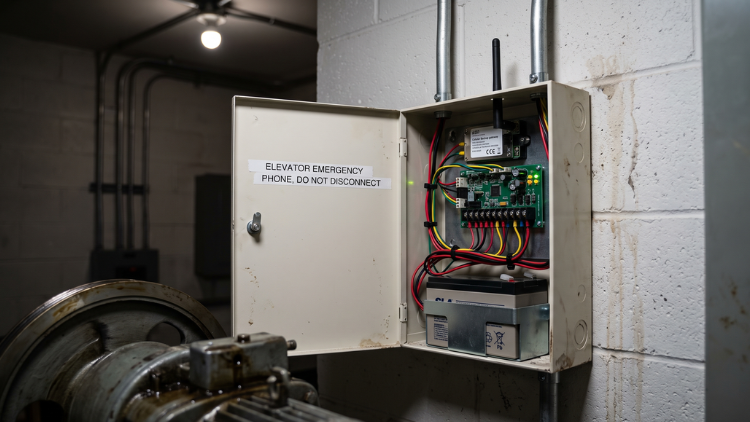
A phone line that fails to meet these overlapping requirements creates real consequences, not just paperwork problems:
- A failed inspection and a red-tagged elevator pulled out of service
- Liability exposure if a trapped passenger can’t reach a live person
- Slower rescue response because dispatchers can’t confirm which cab is calling
- The same violation resurfacing at every future annual inspection until it’s fixed
For a building with multiple elevators, or an association managing several properties, these issues tend to compound rather than stay isolated.
How Does Group One Keep South Florida Elevators Connected and Compliant?
This is exactly the gap Group One Safety & Security was built to close for South Florida building owners. Rather than asking property managers to interpret ASME, ADA, and Florida Building Code language themselves, Group One provides 24/7 elevator emergency phone monitoring through a UL-listed monitoring center, where trained operators answer calls immediately and dispatch help based on what the passenger needs.
The system is built with the “always available” requirement in mind from the start:
- Redundant cellular and VoIP backup pathways
- Routine automated test signals that verify the connection without waiting for an emergency to find a problem
- Immediate alerts to building management if a call fails to connect
- Detailed call logs and compliance reporting for your records
- Optional integration with fire alarm and security monitoring, so testing and billing stay simple across systems
For buildings still relying on aging copper infrastructure, that built-in cellular and VoIP redundancy means a single carrier disconnection doesn’t have to take your elevator phone offline.
Final Takeaways
- “Dedicated” is a functional standard, not a wiring diagram; the emergency call has to win every time, no matter which path it travels.
- ASME A17.1, the ADA, and Florida Building Code Chapter 30 work as a set: one governs the communication itself, one governs accessibility, and one makes both enforceable at the state level.
- Sharing a line without the right safeguards is a preventable, common cause of failed elevator inspections in South Florida.
Frequently Asked Questions
Does every elevator legally need its own dedicated phone line?
Not in the sense of one exclusive wire that never touches anything else. Code requires that the emergency call always gets through to a live person, whether that’s delivered over a single-purpose line or a properly managed shared line with priority seizure.
Can an elevator emergency phone share a line with other equipment in the building?
It’s possible with the right line-sharing hardware, but it introduces more points of failure. Most South Florida inspectors and elevator contractors prefer a line the emergency call wins automatically, without depending on another device to yield first.
What happens if the phone company disconnects my building’s copper line?
Your elevator phone stops working until it’s reconnected through a compliant alternative. Since carriers are retiring copper lines on shorter notice, it’s worth confirming your elevator phone’s connection type before a disconnection notice forces the issue.
Protecting the Treasure Coast since 1984
Talk to a local, licensed team, not a call center. Get a free assessment and a written quote.