How Does a Commercial Fire Alarm System Actually Work
Key Takeaways
- Commercial fire alarm systems are not just detectors and sirens; they are integrated networks of components that detect, alert, and communicate simultaneously.
- NFPA 72 is the national standard governing how fire alarm systems must be designed, installed, inspected, tested, and maintained in the United States.
- Florida businesses must comply with both NFPA 72 and the Florida Fire Prevention Code, which means local requirements can be stricter than the national baseline.
- Buildings such as high-rises, schools, hospitals, restaurants, warehouses, and assembly spaces are legally required to have a compliant fire alarm system in place.
- Non-compliance can result in unannounced fire marshal inspections, fines, forced business closures, and denied insurance claims.
If you own or manage a commercial property in South Florida, a fire alarm system is one of the most important investments you will ever make. But a compliant, properly functioning system is about far more than mounting a few detectors on the ceiling.
It involves a coordinated network of components, strict code requirements, and a regular schedule of professional inspections. Understanding how these systems actually work, and what the law requires of you, is the first step toward protecting your people, your property, and your business license. At Group One Safety and Security, we work with South Florida businesses every day to design, install, and maintain systems that meet every layer of that obligation.
What Is a Commercial Fire Alarm System
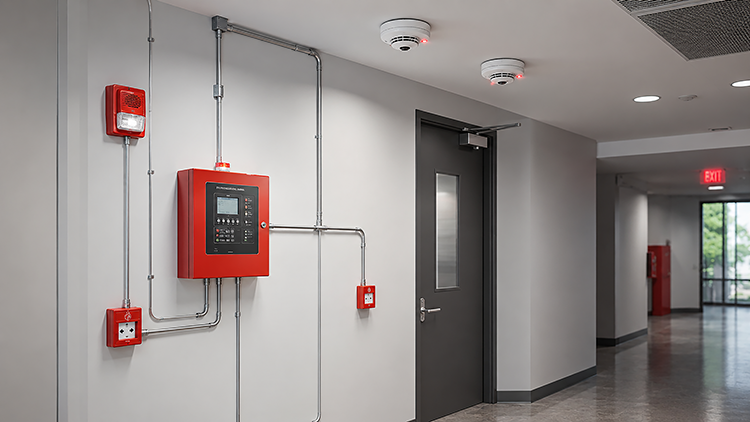
A commercial fire alarm system is a connected network of devices designed to detect fire conditions and alert occupants quickly enough for safe evacuation. According to industry guidance, a commercial fire alarm system is a collection of devices designed to detect and alert building occupants of a potential fire, comprising several components including initiating devices, notification appliances, and control panels that work together to identify smoke or heat and sound an audio or visual alert.
Think of the system as three coordinated layers working in sequence:
- Detection picks up the earliest signs of a fire through smoke, heat, or flame.
- Processing routes those signals through a central control panel that decides what action to trigger.
- Notification alerts occupants inside the building and sends a signal to emergency responders outside.
When all three layers function together, they give your staff and customers the precious seconds or minutes needed to get out safely.
What Are the Core Components of a Properly Installed System
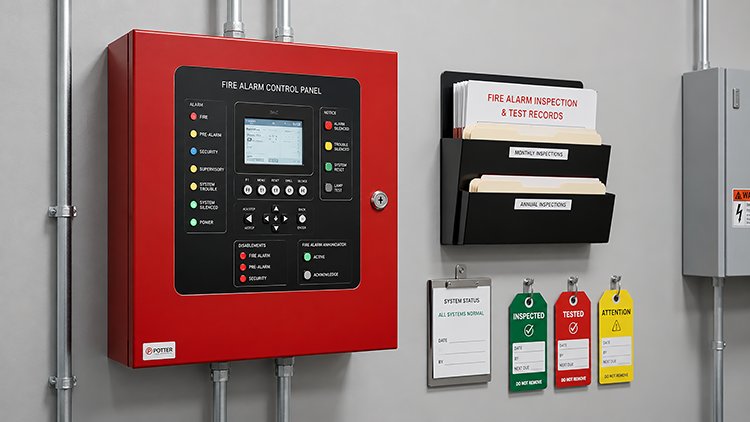
Every code-compliant commercial fire alarm system contains several essential hardware components. Each one plays a specific role, and a system is only as reliable as its weakest part.
Fire Alarm Control Panel (FACP)
The fire alarm control panel is the central hub of the fire alarm system. It receives signals from detectors and activates alarm and notification devices. The panel also controls critical fire and life safety functions such as elevator recall, HVAC systems, and smoke control, and displays conditions including Alarm, Trouble, and Supervisory signals.
It is essentially the brain of the entire operation. If a smoke detector triggers in a second-floor office, the FACP identifies exactly which device is reporting, processes the signal, and simultaneously activates notification devices and alerts your monitoring station. The commercial segment accounts for the largest share of the global fire alarm and detection market, which was valued at $49.6 billion in 2024 and is projected to grow steadily through 2033, according to Straits Research. A clear signal that commercial fire alarm investment is accelerating, not stagnating.
Initiating Devices
Fire alarm initiating devices are the sensory layer of any commercial fire alarm system, the components that detect a fire condition and send a signal to the control panel to initiate an alarm. Under NFPA 72, an initiating device is defined as a system component that originates a change-of-state signal in the fire alarm system.
These include:
- Smoke detectors (photoelectric and ionization types)
- Heat detectors for high-temperature environments like kitchens
- Flame detectors for industrial or warehouse spaces
- Sprinkler water flow sensors that trigger when water moves through the pipes
- Manual pull stations that allow a person to activate the alarm by hand
Notification Appliances
Once the control panel processes a signal, notification appliances activate to alert everyone in the building. Fire alarm notification devices include strobes, chimes, horns, signaling bells, lights, emergency message boards, and speakers. In larger or multi-occupancy buildings, voice evacuation systems broadcast verbal instructions, which can reduce panic and guide occupants more efficiently during an emergency.
Power Supply
NFPA 72 mandates that fire alarm systems have a reliable primary power source as well as a backup, such as a battery or generator, to ensure continued operation during power outages. This is especially important in South Florida, where severe weather and power disruptions are seasonal realities.
Central Station Monitoring
A fully compliant commercial system connects to a 24/7 central monitoring station. Monitoring services must also be verified to ensure signals are reaching the central monitoring station. If your alarm system is not monitored, or if the monitoring contract has lapsed, you are not in compliance. That monitoring connection ensures that if a fire starts at 3 a.m. when your building is empty, the fire department still gets the call. Group One Safety and Security provides 24/7 central station monitoring as part of our commercial fire alarm services, so that connection is always active and verified.
What Is NFPA 72 and Why Does It Apply to Your Business
NFPA 72, formally known as the National Fire Alarm and Signaling Code, is the governing document that defines how commercial fire alarm systems must be built, installed, and maintained in the United States.
NFPA 72 sets the minimum standards for commercial fire alarm installation, performance, testing, inspection, and maintenance. It outlines specific safety regulations for smoke detectors, alarm signaling devices, pull stations, heat detectors, fire alarm control panels, and other requirements. However, systems are only considered fully NFPA 72 compliant if they are installed, inspected, and maintained by skilled, certified professionals.
An important distinction to understand is the relationship between NFPA 72 and the building codes that require you to have a fire alarm system in the first place. The Building or Fire Code determines when a fire alarm system is required. NFPA 72 provides the detailed requirements for how that system must be designed, installed, inspected, tested, and maintained.
In Florida, this means your system must satisfy both the International Building Code (or local equivalent) and the Florida Fire Prevention Code (FFPC), which adopts NFPA 72 with state-specific amendments. Local Authorities Having Jurisdiction (AHJ) can, and frequently do, impose requirements that are stricter than the national baseline.
For South Florida businesses operating in Martin, St. Lucie, Palm Beach, or Broward counties, understanding your local AHJ’s specific requirements is not optional; it is essential. Group One Safety and Security is licensed and experienced across all of these counties, so your system is designed to satisfy the right authority from the start.
Which Types of Commercial Buildings Are Required to Have a Fire Alarm System
Not every building in Florida requires the same level of fire alarm protection, but the list of occupancies that must have a compliant system is broad. Examples of commercial occupancies that require smoke alarms include high-occupancy buildings such as assembly venues (theaters, restaurants), hospitals, schools, high-rise buildings, warehouses, shopping malls, and enclosed commercial spaces like basements.
The following building categories are commonly subject to mandatory fire alarm requirements in Florida:
- Restaurants and food service establishments of any size
- Hotels, motels, and short-term rentals with multiple guest rooms
- Medical offices, clinics, and healthcare facilities
- Schools, daycare centers, and educational facilities
- Retail stores and shopping centers above a certain square footage
- Warehouses and distribution facilities
- Office buildings with multiple tenants or floors
- Assembly spaces such as churches, event venues, and gyms
- Government and municipal buildings open to the public
If you are unsure whether your property type triggers a mandatory requirement, a licensed fire alarm contractor can assess your building and provide clarity before an inspector does it for you. Group One offers site assessments for commercial properties across South Florida to determine exactly what your building requires under current code.
What Does NFPA 72 Code Compliance Actually Mean in Practice
Code compliance is not a one-time event. It is an ongoing commitment that covers every stage of the system’s life cycle: design, installation, and maintenance. The NFPA requires that fire alarm systems be designed based on the specific needs of the building they are protecting.
The layout, size, occupancy type, and fire hazards present within the building determine the system’s complexity. Fire alarm systems must be installed by professionals who understand NFPA 72 and follow local codes and standards.
Compliance means your system must:
- Be designed and installed by a licensed fire alarm contractor registered with the Florida State Fire Marshal.
- Use equipment that matches the occupancy type and physical environment of your building.
- Connect to a central monitoring station with verified signal transmission.
- Be documented with complete records for every inspection, test, and repair.
- Undergo inspections and testing on the schedule mandated by NFPA 72 and Florida statutes.
Your local AHJ has final authority. NFPA 72 is the baseline; local jurisdictions may impose stricter requirements. Working with a provider who knows South Florida’s specific jurisdictional landscape means your system will be built and maintained to the right standard from day one.
What Is the Required Inspection Schedule for Florida Businesses
Florida’s inspection requirements are layered and non-negotiable. Thorough visual inspections and physical testing of the components of your fire alarm system must occur weekly, monthly, quarterly, semi-annually, annually, every five and 10 years, according to the NFPA Standards and your AHJ rules.
Here is a practical breakdown of the schedule most South Florida commercial properties must follow:
Weekly and Monthly (Performed by Trained Staff)
Visual checks of control panel status indicators, battery condition, and any obvious signs of physical damage to detectors or pull stations can be completed by adequately trained in-house staff.
Quarterly (Must Be Documented)
NFPA 72 mandates that more in-depth functional tests be conducted every three months, including testing of notification devices such as horns and strobes and other critical components such as fire alarm control panels.
Semi-Annual
In Florida, business owners are required to perform a visual inspection at least once every six months, during which they must verify that the system is operating correctly and has no visible physical damage.
Annual (Mandatory Licensed Contractor)
Every commercial fire alarm system in Florida must be tested annually by a licensed fire alarm contractor. This includes testing all initiating devices (smoke detectors, pull stations, heat detectors), notification appliances (horns, strobes), and the fire alarm control panel.
Multi-Year (Every 3 and 5 Years)
The State of Florida requires that fire protection systems be tagged annually, quarterly and every 3 and 5 years according to NFPA standards by a fire system company licensed by the State Fire Marshal.
Keeping a complete paper trail of every inspection and test is just as important as conducting them. As the building’s owner or company’s manager, it is your responsibility to retain copies of your inspection and repair records as proof of your compliance with fire codes.
What Are the Real Risks of Non-Compliance
Skipping inspections or operating with a non-compliant system is not a calculated business risk. It is an exposure to consequences that can threaten your ability to operate at all.
Fire marshals conduct unannounced inspections to verify compliance. Businesses that fail to meet NFPA fire safety regulations may face immediate fines, mandatory upgrades, or business shutdowns until issues are resolved.
Missing an inspection can result in a notice of violation, and repeated violations can lead to fines of up to $500 per day until compliance is achieved.
Beyond regulatory fines, the financial exposure compounds in other directions:
- Insurance implications: A non-compliant fire alarm system can be grounds for a denied insurance claim after a fire incident. Your carrier may argue the system failed to meet required standards.
- Legal liability: If an occupant is harmed in a fire and your system was not properly maintained or inspected, you may face serious civil liability.
- Business interruption: A forced closure until compliance is achieved can cost far more than the inspection it would have taken to stay current.
- Reputational damage: Employees, tenants, and customers notice when safety is deprioritized.
According to Florida Statutes 633.3482, it is a misdemeanor of the first degree for any fire alarm system contractor or certified unlimited electrical contractor to intentionally or willfully render inoperative any fire alarm system required by the State Fire Marshal’s rules, except when the system is being serviced, tested, repaired, inspected, or improved.
The cost of compliance is always lower than the cost of non-compliance. Businesses that invest in certified, professionally maintained systems do not just meet a legal obligation; they signal to everyone in the building that safety is a core value.
Final Takeaways
A commercial fire alarm system is one of the most legally and operationally significant safety investments a South Florida business owner can make. Understanding how these systems function, from the control panel to the initiating devices and notification appliances, gives you the foundation to make informed decisions about what your building needs.
NFPA 72 and Florida Fire Prevention Code compliance is not a suggestion; it is a legal obligation backed by inspection schedules, reporting requirements, and meaningful penalties for non-compliance.
The key points to carry forward:
- A properly installed system includes a fire alarm control panel, initiating devices, notification appliances, a dedicated power supply, and a verified monitoring connection.
- NFPA 72 governs how your system must be built and maintained; the building and fire codes determine when you are required to have one.
- Florida requires annual testing by a licensed contractor at a minimum, with semi-annual visual inspections and additional periodic checks for specific components.
- Failing an inspection, operating with a lapsed monitoring contract, or ignoring documented violations carries fines of up to $500 per day, forced closures, and potential civil liability.
The right partner does not just install your system and hand you a certificate. They stay current with your inspection schedule, provide complete documentation, and help you navigate the local requirements specific to your county and municipality.
Group One Safety and Security has been serving commercial property owners across South Florida with licensed, code-compliant fire alarm system installation, testing, and monitoring, so your building stays protected, your records stay current, and your business keeps running.
FAQs: Commercial Fire Alarm Systems in South Florida
Is my small business required to have a commercial fire alarm system in Florida?
It depends on your building type, occupancy size, and local AHJ requirements. Many small businesses, including restaurants, retail stores, and medical offices, are subject to mandatory fire alarm requirements even at modest square footage. A licensed contractor can evaluate your specific situation and confirm what applies to your property.
What is the difference between a conventional and an addressable fire alarm system?
Conventional fire alarm systems have been around for years and are commonly found in older buildings and work by responding to changes in electrical currents, such as when a smoke detector detects smoke and alters the current. Each device in an addressable system has its own address, allowing the control panel to identify the specific device sending a signal, making it easier to locate the source of the fire. For most new commercial installations or system upgrades in South Florida, addressable systems offer significantly better precision and faster response.
Can I perform fire alarm inspections myself?
Basic weekly and monthly visual checks can be completed by adequately trained staff. However, in Florida, quarterly, annual, and multi-year inspections must be conducted by a fire alarm inspection company that is registered with the State Fire Marshal. The only exception is certain government agencies that can conduct their own inspections if personnel are adequately trained.
What documentation do I need to keep for fire alarm compliance?
You should retain records of every inspection, functional test, repair, and component replacement for your fire alarm system. These records need to be producible quickly if a fire marshal visits your property. Working with a licensed contractor who provides detailed electronic documentation after every service visit is the most reliable way to stay protected.
Protecting the Treasure Coast since 1984
Talk to a local, licensed team, not a call center. Get a free assessment and a written quote.