How Do Building Access Control Systems Work, and Why Do South Florida Businesses Need Them?
Key Takeaways:
- Access control systems rely on four working parts (credentials, door controllers, readers, and management software) to decide who can open which door and when.
- Unauthorized entry is a measurable, documented risk for South Florida offices, retail spaces, and multi-tenant buildings, not just a hypothetical one.
- Multi-site businesses face real challenges managing keys, credentials, and terminated employee access across locations without a centralized platform.
- Access control has to work safely alongside fire alarms and emergency exits, not just lock doors.
If you own or manage a business in South Florida, you have probably wondered who actually still has a key to your building, and whether that list is even accurate anymore. Traditional locks and keys make it hard to know who is really coming and going, especially once seasonal staff, contractors, or multiple locations enter the picture. That is the gap that building access control systems are built to close.
At Group One Safety and Security, we design and install access control systems for offices, retail spaces, HOAs, and multi-site operations across South Florida, and we have seen how the right system can help turn ‘who can get through this door’ from a guessing game into a documented, manageable process.
This guide breaks down how access control systems actually work, piece by piece, and connects each part to the risks South Florida businesses deal with regularly: unauthorized entry and the headache of managing more than one location.
What Is a Building Access Control System, Exactly?
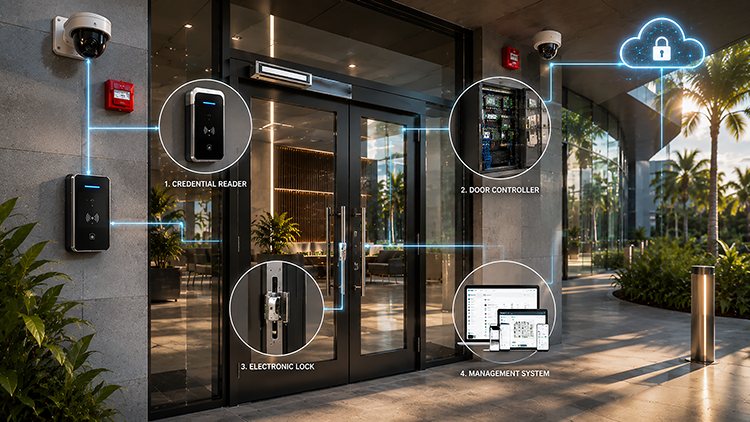
A building access control system is an electronic way of deciding who can open a specific door, at what times, and under what conditions. Instead of a metal key that anyone can copy, lose, or keep after they leave, the system checks a credential (something a person has, knows, or is) against permissions stored in software.
Group One builds these systems to be scalable, so the same underlying approach works whether you have one door or hundreds of them across several buildings.
How Do the Core Components of Access Control Actually Work?
Every access control system, simple or complex, is built from four basic parts working together.
Credentials are how a person identifies themselves to the system:
- Proximity cards or key fobs
- PIN codes entered on a keypad
- Mobile credentials on a smartphone
- Biometric data, such as a fingerprint
Each credential is tied to one specific person and one specific set of permissions. Losing a fob does not mean losing control of the building; you simply deactivate that credential.
Door controllers are the small computers at or near each door. They receive the credential data and decide, in real time, whether to unlock that specific door. This is the decision-making layer between the reader and the physical lock.
Readers are what people actually interact with: a card reader, keypad, or biometric scanner mounted at the door. The reader captures the credentials and passes them along to the controller.
Management software is where permissions actually live. Through cloud-based or on-site software, a facility manager can grant or revoke access instantly, set schedules (for example, employee access only from 8 AM to 6 PM), and pull entry logs after the fact.
Why Does Unauthorized Entry Put South Florida Businesses at Real Risk?
Unauthorized entry is not an abstract concern. The FBI’s Uniform Crime Reporting Program defines burglary as unlawful entry into a structure, a category that explicitly includes offices, not just homes. Florida’s own numbers back this up: in 2024, the statewide burglary rate was 89.7 incidents per 100,000 residents, based on Florida Department of Law Enforcement data published by the Florida Department of Health.
A few local realities raise the stakes further for South Florida businesses specifically:
- Seasonal tourism brings more temporary staff and contractors cycling through buildings, along with more former employees who may still hold a working key.
- Mixed-use and multi-tenant properties, common from Stuart down through Palm Beach, Broward, and Miami-Dade, mean one lost key can compromise more than one business.
- After-hours access to storage rooms, server closets, or cash-handling areas is a common weak point when entry is not tied to an audit trail.
Access control does not just lock a door; it creates a record of who came and went, which is exactly what a traditional key cannot do.
What Happens When You Manage Access Across Multiple South Florida Locations?
Managing keys across two, five, or twenty locations by hand tends to break down eventually. The usual problems look like this:
- A terminated employee still has a working key or fob at a location nobody thought to update.
- No single person has a full view of who has access to what across every site.
- Schedules are inconsistent; one location locks down at 6 PM and another does not.
Cloud-based access control management solves this by putting every site under one dashboard. You can revoke a person’s access, apply consistent schedules, and pull a report for any door, at any site, all without physically visiting the building.
How Does Access Control Work With Fire Alarms and Emergency Exits?
Access control has to coexist with life safety requirements, not override them. Under the National Fire Protection Association’s Life Safety Code (NFPA 101), electronically locked doors used for egress must unlock automatically if the fire alarm activates or the system loses power, and they cannot require a key, tool, or special knowledge to open from the inside during an emergency.
This is exactly why access control needs to be designed alongside fire alarm and life safety systems, not added on afterward. A poorly configured electronic lock can create a genuine life safety violation, even when it was installed with good intentions.
Why Does Professional Design and Installation Matter?
A basic keypad from a hardware store can secure a single door. It generally cannot do the following, which is where professional design comes in:
- Assign custom permissions by role, department, or schedule
- Integrate with existing video surveillance and intrusion alarms, so a forced door triggers a camera clip and an alert
- Help ensure your door hardware doesn’t conflict with your emergency egress plan
- Scale from a single door to a full multi-building campus without starting over
Group One Safety and Security has designed and installed security systems for South Florida businesses since 1984, and access control is one part of a broader approach that also includes video surveillance, intrusion alarms, and fire alarm systems. Because we work across all of these systems ourselves, we can design access control that communicates with your cameras, your alarms, and your emergency egress requirements as one coordinated system, rather than several disconnected ones.
Final Takeaways
Building access control comes down to four parts working together: credentials, door controllers, readers, and management software. For South Florida businesses, getting that combination right matters for more than convenience; it affects real, ongoing risks like unauthorized entry, multi-site management, and fire and life safety code requirements.
A system designed to handle all of that, rather than just lock a single door, is the difference between a genuine security upgrade and a false sense of security. Group One Safety and Security has spent decades helping South Florida businesses design access control systems that fit how they actually operate, and we are ready to help you figure out what that looks like for your building.
FAQs About Building Access Control Systems
What credentials can be used with a building access control system?
Common options include proximity cards, key fobs, PIN codes, mobile credentials on a smartphone, and biometric readers such as fingerprint scanners. Many businesses mix credential types, using cards for staff and PIN codes for occasional visitors or contractors.
Can access control integrate with the cameras and alarms we already have?
In most cases, yes. Modern access control platforms are designed to work alongside video surveillance and intrusion alarm systems, so a forced door or a held-open alert can automatically trigger a camera recording or a notification.
Does access control affect our fire alarm or emergency exit requirements?
It can, if it is not designed correctly. Life safety codes require doors used for egress to unlock automatically during a fire alarm event or a power failure. This is a key reason access control should be planned alongside your fire and life safety systems, not separately from them.
Can one system manage access across multiple South Florida locations?
Yes. Cloud-based management software is built for exactly this, letting a facility manager oversee credentials, schedules, and entry logs for every site from a single dashboard.
Protecting the Treasure Coast since 1984
Talk to a local, licensed team, not a call center. Get a free assessment and a written quote.