How Does Elevator Alarm Monitoring Work in Stuart, FL?
Key Takeaways
- An elevator alarm isn’t a standalone device; it’s one end of a live connection to a UL-listed monitoring center that must reach a trained operator, not just ring.
- Remote testing checks the signal path itself (line health, connection, audio clarity) on a routine basis, which is how a failing phone line or dead cellular path gets caught before it matters.
- ASME A17.1 requires that if an elevator emergency call is not acknowledged by authorized personnel within 45 seconds, it automatically diverts to an alternate location.
- When an alert comes in, an operator has to confirm the building and car, talk to the passenger, and decide who to send: building staff, an elevator technician, or 911.
Every elevator in a Stuart, FL building has a phone or call button that’s supposed to connect a trapped or frightened passenger to help. What most property managers don’t see is everything that has to happen correctly behind that button for it to actually work when it’s pressed: the signal path, the test cycle and the dispatch decision. Group One Safety & Security provides 24/7 elevator emergency phone monitoring built around exactly those pieces, for commercial buildings, condos, HOAs, and multi-tenant facilities across South Florida.
This piece walks through that process step by step: how the alarm reaches a monitoring center, what remote testing is actually checking, how an alert gets handled once it arrives, and why buildings across South Florida lean on a professional provider instead of handling it in-house.
How Does an Elevator Alarm Connect to a Monitoring Center?
When someone presses the “Phone” button inside an elevator cab, it isn’t dialing a random number. It’s triggering a dedicated communication path built into the elevator’s design, and that path has a specific job: reach a location staffed by trained personnel, every time.
That path typically runs through a few layers:
- The in-cab unit – the phone, speaker, and microphone mounted near the call button, built for hands-free, two-way voice communication.
- The transmission line – a cellular, IP, or telephone connection that carries the call out of the building.
- The monitoring center – a UL-listed central station where an operator is on duty around the clock.
- The response layer – the people the operator can reach once the call is answered: building staff, an elevator technician, or emergency services.
Group One’s monitoring center is UL-listed, answers these calls immediately, and provides voice response and dispatch when needed. The point of this layered design is redundancy: if one part of the path is compromised, there’s still a way for the call to get through.
What Actually Happens During Remote Testing?
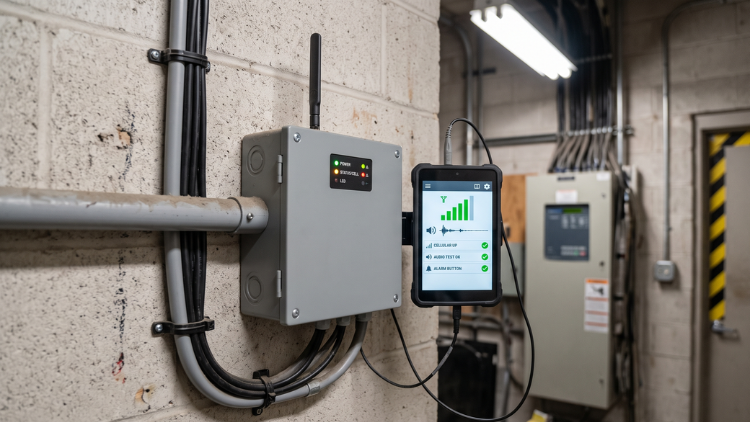
This is the part of elevator alarm monitoring that does the most quiet work. Remote testing isn’t a single event; it’s a routine, automated process that checks whether the communication path is still intact, long before anyone needs to use it.
A remote test typically verifies:
- That the line (cellular, IP, or phone) still connects to the monitoring center at all.
- That audio comes through clearly enough for a real conversation.
- That the signal reaches a live operator, not a dead end or busy tone.
- That backup paths, where installed, are also functioning.
Industry guidance is consistent on why this matters: ASME A17.1 requires annual testing of elevator emergency communication, but monthly operational checks by maintenance staff, owners, or monitoring centers are strongly recommended to catch problems long before the annual test does.
That gap between “annually required” and “monthly recommended” is exactly where failures hide. A cellular module can lose signal, a phone line can go quiet, or a VoIP connection can drop, all without any visible sign in the elevator cab. Remote testing is how that gets caught on a routine schedule rather than during an actual emergency, or during an inspector’s visit.
Why Does the 45-Second Rule Matter?
Elevator alarm monitoring isn’t just about connecting a call; it’s about connecting it fast enough. ASME A17.1 requires that if a call isn’t acknowledged by authorized personnel within 45 seconds, it must automatically divert to an alternate location.
This single rule explains a lot about how monitoring providers are structured. A 45-second window doesn’t leave room for a call to ring at an empty front desk or bounce to voicemail. It requires:
- A live operator on duty at all times, not just during business hours.
- A system built to detect a missed acknowledgment and reroute automatically.
- Documentation showing the call was acknowledged within that window.
For Stuart, FL buildings, this isn’t a suggestion; it’s the baseline the state has adopted into its elevator safety code.
What Happens Behind the Scenes When an Alert Comes In?
Once a call reaches the monitoring center, the operator’s job starts immediately. This isn’t a scripted, automated response; it’s a live person working through a sequence:
- Identify the location: The operator confirms the building and the specific elevator car, information the system is built to provide automatically.
- Establish two-way voice: The operator speaks directly with the passenger to understand what’s happening (mechanical failure, entrapment, medical concern).
- Acknowledge the call: A visual indicator activates in the cab, letting the passenger know help has been reached.
- Decide who to send: Depending on the situation, that could mean building management, an on-call elevator technician, or a direct dispatch to 911.
- Log the event: The call, the response, and the outcome all get recorded for compliance and liability records.
That last step matters more than it might seem. Detailed call logs are part of what turns a single answered call into a documented compliance record, the kind of paper trail an inspector or insurance carrier will ask for.
Final Takeaways
- Elevator alarm monitoring is a full communication chain, from the in-cab unit to a UL-listed center to a live dispatch decision, and every link has to hold.
- Remote testing exists to catch a failing line or dead signal on a routine schedule, not during an actual emergency.
- Documentation from every call and every test is what turns a working system into a defensible compliance record.
Frequently Asked Questions
What happens if a remote test finds a problem with the line?
If a test signal doesn’t confirm a clean connection, the monitoring center flags it and alerts building management directly, so the issue can be addressed by a technician before it results in a failed inspection or an unanswered call.
What happens to elevator alarm monitoring during a power outage or storm?
This is a real concern in South Florida. Redundant communication pathways (cellular and VoIP backups, for example) are built in specifically so a call can still get through if one connection type goes down during an outage.
Can elevator alarm monitoring be combined with fire alarm or security monitoring?
Yes. Group One offers integrated monitoring that combines elevator phones with fire alarm, intrusion, and access control systems, which simplifies testing schedules and billing for multi-tenant and commercial properties.
Who actually gets dispatched when an elevator alarm goes off?
It depends on what the operator learns during the call. It could be building management, an on-call elevator technician, or a direct dispatch to 911, depending on whether the situation is mechanical, a simple entrapment, or a medical emergency.
Protecting the Treasure Coast since 1984
Talk to a local, licensed team, not a call center. Get a free assessment and a written quote.