Elevator Monitoring System in South Florida: What Building Owners Must Know for ADA & ASME Compliance
Key Takeaways
- ASME A17.1 requires elevator emergency communication to reach a live, authorized person, hands-free, with no handset; if it first hits an automated system, that system must connect the caller to a real person within 45 seconds or reroute automatically.
- A missed or unanswered elevator call isn’t a minor glitch; it’s a documented deviation from code that can show up on your next inspection report.
- Group One Safety & Security installs and monitors elevator communication systems around these exact ADA, ASME A17.1, and Florida Building Code requirements, using a UL-listed monitoring center and redundant cellular/VoIP backup lines.
If you own or manage a commercial building, condo, or HOA in South Florida, you already know an elevator phone has to work. What’s less obvious is exactly what “working” means under code. ASME A17.1, the ADA, and Florida Building Code Chapter 30 all specify precise, testable requirements, down to response times and button placement, and falling short on any one of them can put your certificate of operation at risk. Group One Safety & Security installs and monitors elevator communication systems across South Florida that are built to meet or exceed these exact requirements, not just built to pass a single inspection.
This isn’t a general explainer on what elevator monitoring is. It’s a breakdown of what actually makes a system compliant, where South Florida buildings tend to fall short, and why the equipment in the cab is only half the story.
What Actually Makes an Elevator Monitoring System ADA and ASME Compliant?
Compliance isn’t just “there’s a phone in the elevator.” ASME A17.1 requires the call to connect with authorized personnel, not an automated answering system, and the connection has to lead to a trained person who can actually act on it, not just ring an unanswered line or dead-end in a generic answering service. A device is allowed to route through an automated system first, but only if that system connects the caller to a live person within 45 seconds.
Three elements have to work together for a system to actually meet code:
- Hardware: a labeled, hands-free “HELP” button and visual indicator inside the car
- Connectivity: a reliable line to a staffed answering point, with backup if the primary path fails
- Response: trained personnel who acknowledge the call, communicate, and dispatch help
Miss any one of the three, and the system can look compliant while quietly failing code.
What Is the 45-Second Rule, and Why Does It Exist?
ASME A17.1, section 2.27.1.1.2, requires that if an emergency call is not acknowledged within 45 seconds, it automatically redirects to another monitoring location. State elevator regulators who administer the code describe this plainly: operators must attempt two-way communication and, if contact can’t be made, assume the worst and summon emergency responders.
This is where a lot of self-managed or informally monitored systems break down. A single phone line ringing to a front desk, a maintenance cell phone, or an answering service without a documented escalation path has no built-in way to meet that 45-second failover if the first attempt goes unanswered. A code-compliant system needs that redirect built in, tested, and logged.
How Do Visual Indicators Fit Into Compliance?
Once a call connects, ASME A17.1 requires the authorized personnel to activate a visual signal inside the car confirming the link is live. That light has to stay on until the operator, not the passenger, ends the call. This protects passengers who are deaf or hard of hearing by giving them visual confirmation that help is coming, even without audible cues.
It also protects building owners. A visual indicator that never activates, or one that a passenger can turn off themselves, is an easy compliance gap for an inspector to catch.
What Does Florida Building Code Chapter 30 Actually Require?
The 8th Edition Florida Building Code took effect December 31, 2023, and incorporates ASME A17.1-2019 as the enforced elevator safety code statewide. The DBPR Bureau of Elevator Safety adopted its related elevator safety rule on January 30, 2024.
Under this framework, every covered elevator must pass an annual inspection by a certified elevator inspector, and a building’s certificate of operation cannot be renewed without a current, satisfactory result. For South Florida buildings, that means the emergency phone and monitoring setup isn’t just tested once at installation; it’s re-checked every year, indefinitely.
Who Is Liable When an Elevator Call Goes Unanswered?
Beyond the inspection consequences, an unanswered call is a documented deviation from a life-safety code your building was required to meet. If someone is injured while trapped and unable to reach help, that gap in your monitoring record becomes part of the story, regardless of who installed the original equipment. This is general information, not legal advice; a building owner facing an actual incident should talk to their attorney and insurance carrier about their specific exposure.
What building owners can control is whether that gap exists in the first place. That means:
- Documented, tested response times, not assumptions
- A verified escalation path if the first point of contact doesn’t answer
- Call logs that prove the system worked, or show exactly where it didn’t
Why Do Redundant Cellular and VoIP Backup Lines Matter So Much Here?
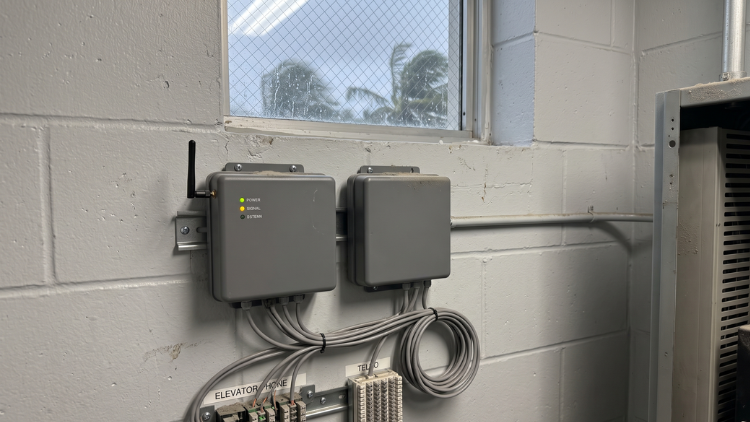
South Florida buildings face a specific version of this risk: hurricane season, storm-related outages, and aging copper phone infrastructure all threaten the single line an elevator phone depends on. A system tied to one telephone circuit with no backup can pass inspection today and go silent during exactly the kind of event when occupants are most likely to need it.
Group One builds redundancy into elevator monitoring by pairing cellular and VoIP backup paths, so a single point of failure in one carrier or line doesn’t take the entire emergency communication system offline. Routine automated test signals confirm the path is live, and if a fault is detected, building management is alerted before it becomes a failed inspection or, worse, an unanswered call.
Why Professional Installation and UL-Listed Monitoring Matter More Than Self-Managed Equipment
Not all monitoring is equal, and code doesn’t just care about the hardware in the cab. UL 827, the Standard for Central Station Alarm Services, sets requirements for the monitoring center itself: facility construction, staffing, equipment redundancy, and annual third-party audits to confirm ongoing compliance. A phone that rings to an unverified answering point, or a system a building manages in-house without that oversight, doesn’t carry the same accountability.
Group One Safety & Security operates a UL-listed monitoring center for elevator emergency calls, with trained operators available 24/7, detailed call logging for compliance records, and the option to bundle elevator monitoring with fire alarm and security monitoring under one service relationship. For South Florida building owners, that means one accountable partner responsible for the full chain: hardware, connectivity, response, and documentation.
Final Takeaways
- Compliance lives in the details: hands-free hardware, a live authorized responder, the 45-second acknowledgment window, and a visual indicator that behaves exactly as code requires.
- Redundant cellular and VoIP backup lines aren’t an upgrade; in a region defined by storms and aging phone infrastructure, they’re what keeps a single outage from becoming a code violation.
- UL-listed monitoring adds a layer of verified accountability that self-managed phones and generic answering services simply can’t match.
Frequently Asked Questions
Does every commercial elevator in South Florida need continuous monitoring, or is an emergency phone enough?
A phone alone isn’t sufficient if it doesn’t connect to a staffed, authorized location capable of two-way voice communication and dispatch. ASME A17.1 and the Florida Building Code both require that live connection.
Can a self-monitored or landline-only elevator phone still meet ADA and ASME requirements?
It’s possible on paper, but risky in practice. Without a documented redundancy path and a trained answering point, a single-line setup has no reliable way to guarantee the 45-second failover or hands-free operation code requires, especially during a line outage.
What should a property manager do immediately after a failed elevator inspection?
Get the cited violations corrected within the timeframe on the notice, typically 30 to 90 days, and schedule the required callback inspection. Involving your elevator monitoring provider early helps confirm the communication system itself isn’t the source of the citation.
Protecting the Treasure Coast since 1984
Talk to a local, licensed team, not a call center. Get a free assessment and a written quote.