When Is a Fire Sprinkler System Required for Commercial Buildings

Key Takeaways
- Florida law mandates fire sprinkler systems in most new commercial buildings over 5,000 square feet under the Florida Fire Prevention Code.
- Building type, occupancy classification, and square footage are the three primary factors that determine whether a sprinkler system is legally required.
- Existing buildings undergoing major renovations or a change of occupancy may trigger retroactive sprinkler requirements under Florida statutes.
- NFPA 25 requires regular inspection, testing, and maintenance of sprinkler systems.
When Is a Fire Sprinkler System Required
If you own or manage a commercial building in South Florida, understanding fire sprinkler requirements is not just a matter of code; it is a matter of life safety, legal liability, and business continuity. Yet many property owners only discover the rules after a failed inspection or a costly code violation notice.
The question ‘when is a fire sprinkler system required’ does not have a single answer. It depends on your building type, its occupancy classification, its size, its age, and whether you are constructing new or renovating existing space. Florida follows its own statewide fire prevention code, which builds on national standards set by the National Fire Protection Association (NFPA).
This guide breaks down exactly when a fire sprinkler system becomes legally mandatory for commercial properties in Florida and what you need to do to stay compliant and protected.
What Laws Govern Fire Sprinkler Requirements in Florida
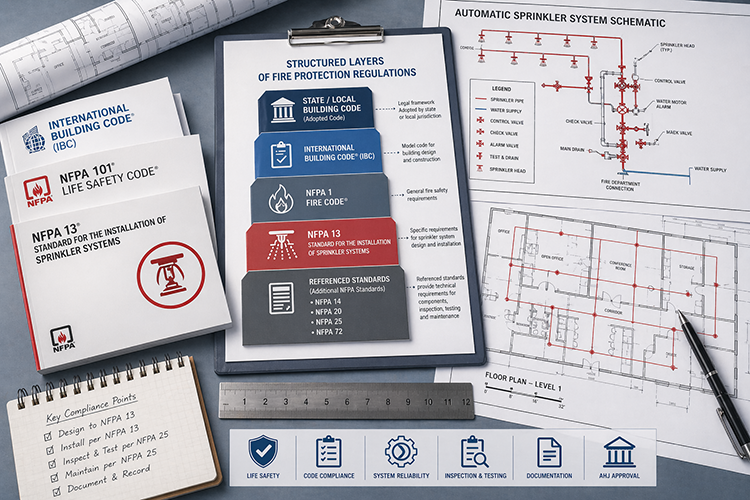
Florida operates under the Florida Fire Prevention Code, which the State Fire Marshal’s Office adopts and updates on a regular cycle. The current edition incorporates NFPA 1 (Fire Code) and NFPA 101 (Life Safety Code) as foundational references.
These codes work alongside the Florida Building Code to set clear benchmarks for when automatic fire suppression systems including wet pipe, dry pipe, and deluge sprinkler systems, must be installed.
Local jurisdictions, including Miami-Dade, Broward, Palm Beach, and Martin counties, may adopt amendments that are equal to or more stringent than the state code. Always verify local requirements before assuming state minimums apply.
Not sure which local fire codes apply?
Martin, Palm Beach, and Broward counties can add stricter rules. Our licensed Stuart team can review your property for code compliance.
Does Building Size Determine If Sprinklers Are Required
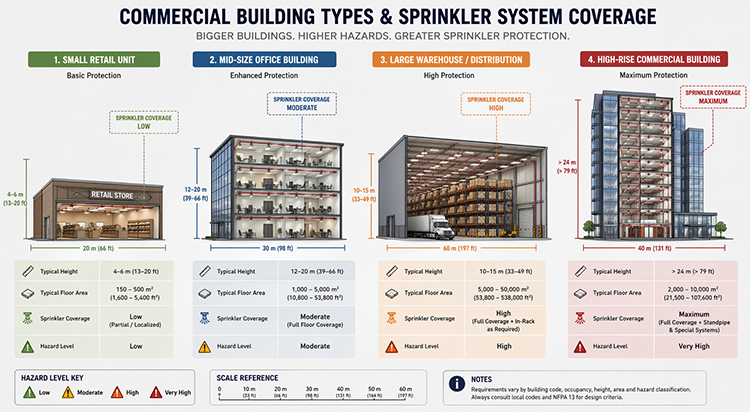
Square footage is one of the most common triggers for mandatory sprinkler installation in Florida. As a general rule, any new commercial building over 5,000 square feet must be equipped with an automatic fire sprinkler system under the Florida Fire Prevention Code.
However, size alone does not tell the whole story. The occupancy type and the level of fire hazard within the building significantly affect the threshold. Here is a simplified breakdown by size:
- Under 5,000 sq ft: Sprinklers may still be required depending on occupancy type and local amendments
- 5,000 – 12,000 sq ft: Mandatory for most commercial occupancies under new construction rules
- Over 12,000 sq ft: Automatic sprinkler requirements apply almost universally, with no exceptions
- High-rise buildings (over 75 feet): Full sprinkler coverage required regardless of square footage
It is also important to note that attached or connected structures are often counted together. A business that expands its footprint through additions may unknowingly cross a square footage threshold that triggers code compliance for the entire structure.
Which Occupancy Types Face the Strictest Sprinkler Rules
NFPA 101 divides buildings into occupancy classifications, and each class carries its own fire protection requirements. Some occupancies trigger mandatory sprinkler installation regardless of building size due to the vulnerability of occupants or the nature of the hazard present.
High-risk occupancies with strict sprinkler mandates in Florida include:
- Assembly occupancies (churches, auditoriums, arenas): Required for new construction over 12,000 sq ft and existing buildings with significant renovation
- Educational occupancies (schools, daycare centers): Required in most new buildings and often retroactively in renovated facilities
- Health care occupancies (hospitals, nursing homes): Required universally due to non-ambulatory occupant risk
- Lodging and residential board/care facilities: Required under NFPA 101 Chapter 32 and 33 for most new construction
- Hotels and motels: All new construction requires full sprinkler coverage per Florida code
- Industrial and storage occupancies: High-hazard contents often trigger requirements below the 5,000 sq ft threshold
Even lower-risk occupancy types, such as office buildings and retail spaces, are not exempt from the general new construction rule once they exceed the square footage trigger. When in doubt, a licensed fire protection engineer should review your building classification before any construction or renovation begins.
Are Existing Buildings Required to Add Sprinklers
One of the most frequently misunderstood aspects of the Florida fire code is the question of existing buildings. Many property owners assume that if their building was constructed before modern codes, it is automatically grandfathered in. That is not always true.
Retroactive sprinkler requirements can be triggered in existing buildings when:
- The building undergoes a change of occupancy for example, converting a warehouse to a restaurant or a retail space to a health care facility
- Major renovation work exceeds a defined percentage of the building’s value (typically 50% or more in Florida)
- A building is reclassified to a higher-hazard occupancy type
- An addition increases the total square footage past a code threshold
- The local fire marshal or Authority Having Jurisdiction (AHJ) determines that life safety conditions have materially changed
Florida Statute 633.216 and related provisions give fire marshals broad authority to require upgrades to existing buildings where conditions have changed. If you are planning a renovation or change of use, consult with a licensed fire protection contractor before finalizing any permits.
What Are the High-Rise and Special Use Requirements
Florida has specific and non-negotiable requirements for high-rise structures. Under Florida Statute 633.202 and the Florida Building Code, any building greater than 75 feet in height measured from the lowest level of fire department access must have a fully automatic fire sprinkler system installed throughout the entire structure.
This requirement applies to all high-rises, regardless of their use, including residential, commercial, mixed-use, or otherwise. Other special-use categories with elevated requirements include:
- Underground structures and windowless buildings: NFPA 101 treats these as extremely high risk, requiring full suppression systems
- Covered mall buildings: Florida requires sprinkler systems in all common areas and tenant spaces
- Atrium spaces: Any building with an atrium connecting three or more stories requires sprinkler protection per NFPA 13
- Hazardous materials storage: The presence of flammable liquids, gases, or certain chemicals triggers NFPA 30 and related sprinkler requirements
What Does NFPA 25 Require After Installation
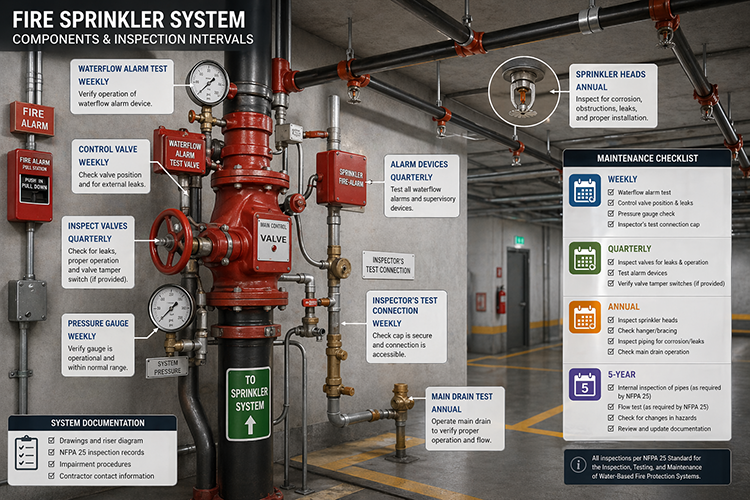
Installing a fire sprinkler system is just the beginning. Once your system is in place, NFPA 25, the Standard for the Inspection, Testing, and Maintenance of Water-Based Fire Protection Systems, becomes your ongoing compliance guide.
NFPA 25 mandates a structured schedule of inspections and tests to ensure your system will function correctly when needed. The key requirements are:
- Weekly and monthly: Visual inspections of gauges, control valves, and alarm devices
- Quarterly: Testing of waterflow alarms, pressure gauges, and supervisory signal devices
- Annual: Full inspection of all sprinkler heads, pipe conditions, hangers, and system components
- Every 5 years: Internal pipe inspection to check for corrosion, microbiologically influenced corrosion (MIC), and obstruction
- Every 50 years (or sooner): Sprinkler head replacement testing to verify that older heads have not lost sensitivity
Failure to comply with NFPA 25 can result in your property insurance being voided, your fire protection system being tagged as out of service, or local fire marshal citations that may force the temporary closure of your facility. Documentation of all inspections must be maintained and made available to inspectors on demand.
Is your sprinkler system keeping up with NFPA 25?
Missed inspections can lead to citations or insurance problems. Our licensed technicians handle NFPA 25 inspection and testing across South Florida.
How Do You Know Which Sprinkler System Design Is Right for Your Building
Not all fire sprinkler systems are the same. The right system for your building depends on your occupancy classification, the nature of the hazards present, and environmental conditions, particularly relevant in South Florida’s humid, coastal climate.
The primary system types used in commercial applications include:
- Wet pipe systems: The most common type, where water is constantly in the pipes and discharges immediately when a head activates. Ideal for most climate-controlled commercial spaces
- Dry pipe systems: Pipes contain pressurized air rather than water, releasing when a head activates, better for unheated or outdoor-exposed spaces
- Pre-action systems: Require two independent events to release water, used in data centers, server rooms, and spaces where accidental discharge is a major concern
- Deluge systems: All heads open simultaneously when triggered, required for aircraft hangars, chemical storage, and extreme-hazard occupancies
A licensed fire protection engineer or contractor will perform a hazard analysis and hydraulic calculation to determine what system design meets both NFPA 13 requirements and your specific building conditions. Attempting to design a system without professional guidance is both dangerous and likely to result in an inspection failure.
Final Takeaways
What Every South Florida Property Owner Should Remember
- Florida’s fire code requires sprinkler systems in most new commercial buildings exceeding 5,000 square feet and in virtually all high-rise structures over 75 feet.
- Occupancy type matters as much as size; health care, lodging, assembly, and educational buildings carry some of the strictest requirements in the state.
- Existing buildings are not always exempt; renovation, change of use, or expansion can trigger retroactive sprinkler requirements under Florida statutes.
- NFPA 25 mandates ongoing inspections and maintenance after installation; compliance is a continuous obligation, not a one-time event.
- Working with a licensed, experienced fire protection provider is the clearest path to staying compliant, avoiding penalties, and keeping your building and occupants safe.
At Group One Safety and Security, we understand the unique fire protection demands facing commercial property owners across South Florida, from small businesses in Stuart to large mixed-use developments in Miami-Dade and Broward counties. Our licensed team provides expert fire sprinkler inspection, testing, and maintenance services fully aligned with NFPA 25, the Florida Fire Prevention Code, and your local jurisdiction’s requirements. When compliance is on the line, Group One Safety and Security is the partner South Florida property owners trust to get it right.