CCTV Camera System for Business: What Every South Florida Owner Needs to Know
Key Takeaways
- A professionally installed CCTV camera system for business does far more than record footage; it actively deters crime, protects employees, and reduces liability exposure.
- Modern commercial surveillance systems offer HD and 4K resolution, night vision, smart motion analytics, and real-time remote viewing from any device.
- Coverage planning is critical; the wrong camera placement leaves blind spots that criminals and liability events can easily exploit.
- Businesses in South Florida face unique security challenges, including high foot traffic, humidity-related equipment wear, and storm-season considerations, which require locally experienced installers.
- Cloud and on-site NVR storage options each carry different benefits, and the right choice depends on your business size, compliance needs, and budget.
Why Is a CCTV Camera System Important for Your Business
If you own or manage a commercial property in South Florida, the question is not whether you need a CCTV camera system. The question is whether the one you have (or plan to install) is actually doing its job.
Research published in a 40-year systematic review by the U.S. Office of Justice Programs confirms that CCTV is associated with a significant and consistent decrease in crime, with the strongest effects seen in parking lots, commercial properties, and residential areas.
A well-designed CCTV camera system for business works on two levels simultaneously. First, it deters bad actors before an incident occurs. Research consistently shows that visible surveillance cameras reduce the likelihood of theft and vandalism. Second, when something does happen, recorded footage provides clear, time-stamped evidence for law enforcement, insurance claims, and internal investigations.
For South Florida businesses, especially where tourism, retail, and hospitality industries drive heavy daily foot traffic, having eyes on your property at all times is not a luxury. It is a core component of responsible business operations.
What Types of Business Surveillance Cameras Should You Consider
Not all security cameras are built for the same environment or purpose. Choosing the right camera type for each area of your facility is one of the most important decisions in building an effective CCTV system. Here is a breakdown of the most common options for commercial use:
Dome Cameras: These are popular for indoor environments like lobbies, retail floors, and hallways. Their compact, ceiling-mounted design makes them discreet and difficult to tamper with. The wide-angle lens covers broad areas without creating obvious dead zones.
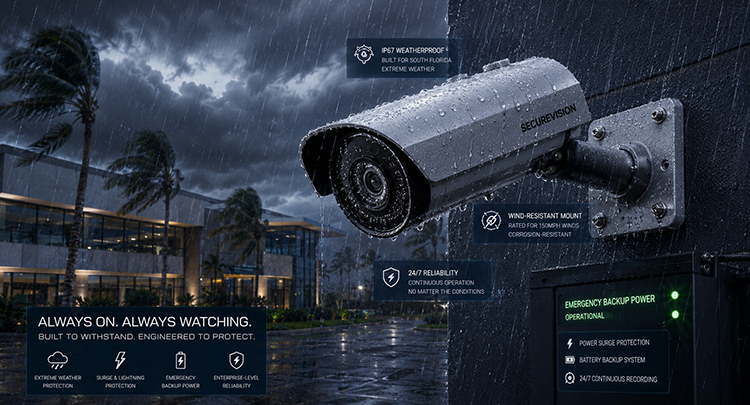
Bullet Cameras: Bullet cameras are ideal for outdoor use. They are built to withstand weather conditions, provide long-range visibility, and serve as a strong visual deterrent when mounted at building entrances, parking areas, or loading docks. In the Florida heat and humidity, weatherproof-rated bullet cameras are essential.
PTZ (Pan-Tilt-Zoom) Cameras: These are remote-controlled cameras that can pan across wide areas, tilt up or down, and zoom into specific points of interest. They are commonly used in large open spaces like warehouses, parking lots, and campuses where a single fixed camera cannot cover the full area.
Turret (Eyeball) Cameras: A flexible option for both indoor and outdoor use, turret cameras allow adjustable viewing angles after installation. They are often preferred in spaces that may need repositioning over time without requiring new hardware.
Infrared and Low-Light Cameras: South Florida businesses that operate at night or have low-light areas such as stairwells, back corridors, and exterior dock areas need cameras with infrared (IR) capability. These cameras provide clear footage in complete darkness, which is critical for after-hours security coverage.
License Plate Recognition (LPR) Cameras: For businesses with parking facilities, drive-throughs, or gated access, LPR cameras capture and log vehicle plate numbers with high accuracy. This is particularly valuable for tracking incidents or managing authorized vehicle access.
How Do You Plan Camera Coverage for a Commercial Property
Poor coverage planning is the most common mistake businesses make when installing a CCTV camera system. Cameras pointed at the wrong angles, placed too far from key zones, or unable to capture usable facial or license plate detail make the entire investment far less effective.
A professional coverage plan should account for the following:
- Entry and exit points: Every door, gate, and window should be covered. This includes employee entrances and emergency exits, not just the main public entry.
- High-value and high-risk areas: Cash registers, server rooms, stockrooms, pharmaceutical storage, and safes require dedicated close-up coverage.
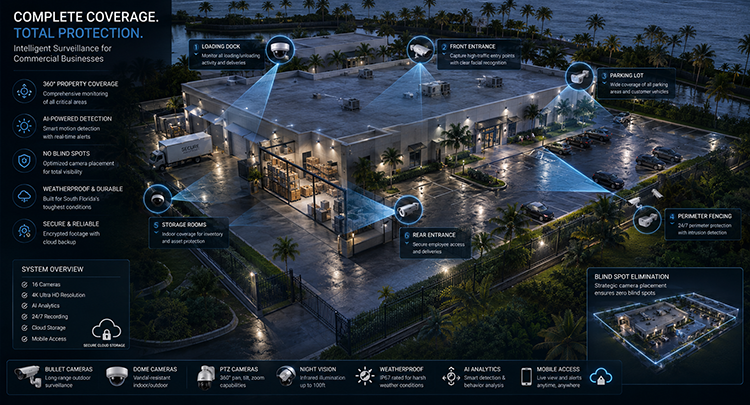
- Parking lots and perimeters: Outdoor coverage should extend far enough to capture approaching vehicles and individuals before they reach the building.
- Blind spot elimination: Interior layouts often have corners, columns, or shelving that create natural blind spots. A site walkthrough by a trained installer identifies and addresses these gaps.
- Lighting conditions: Areas with strong backlighting (such as glass storefronts facing the sun) can wash out camera images without the right camera type or placement angle.
In South Florida, businesses also need to plan for storm season. Cameras mounted on exterior surfaces should be rated for wind and rain, and installation points should be chosen to minimize exposure to hurricane-force conditions.
What Are Your Video Storage Options
Once your cameras are capturing footage, that footage needs to go somewhere reliable and retrievable. Businesses today have two primary storage paths to consider, and each has its place depending on your operation.
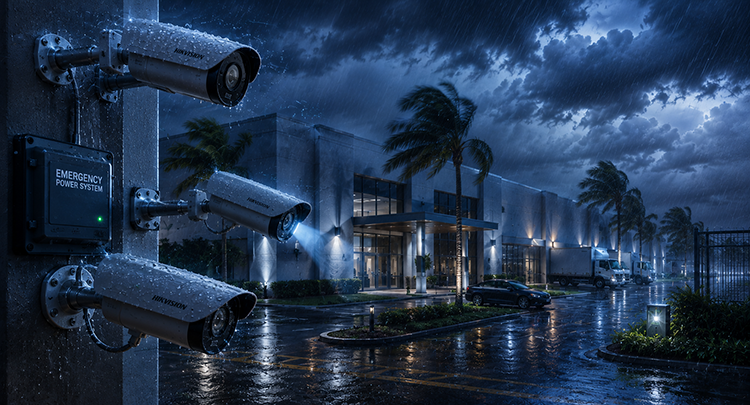
On-Site NVR (Network Video Recorder) Storage: An NVR system stores recorded video locally on a dedicated device within your facility. This option provides fast access to footage, eliminates recurring cloud fees, and keeps your data entirely within your control. However, if the device is damaged, stolen, or destroyed in a fire or flood, that footage may be lost. For South Florida businesses where storm damage is a real concern, physical redundancy or a hybrid approach is worth considering.
Cloud Storage: Cloud-based storage sends footage to a remote server over your network. Because the data is stored off-site, it is protected from local events like break-ins or natural disasters. Cloud storage also enables easy remote access and sharing with law enforcement or insurance adjusters. The trade-off is that ongoing storage fees and sufficient upload bandwidth are required to keep the system running smoothly.
Hybrid Storage: Many commercial CCTV systems today support a hybrid approach, storing recent footage locally for fast access while backing up critical clips to the cloud. This gives businesses the best of both worlds and is the approach we frequently recommend for medium to large commercial properties.
How Does Remote Video Access Change Business Security
One of the most significant shifts in modern commercial surveillance is the ability to monitor your business from anywhere, in real time. Whether you are at a second location, traveling, or simply away from the property after hours, remote access puts your eyes on the ground without requiring you to be physically present.
With a properly configured CCTV camera system for business, remote access allows you to:
- View live feeds from all cameras via a secure mobile app or web browser
- Receive instant push notifications when motion or intrusion events are detected
- Review and download recorded footage for incidents or audits
- Share access with managers, security staff, or law enforcement as needed
- Set custom alert schedules so you are only notified during off-hours or unusual activity
For multi-location businesses across South Florida, such as retail chains, restaurant groups, or property management companies, remote video access is especially powerful. You can oversee every location from a single dashboard without physically visiting each site, which saves time and provides immediate situational awareness when something goes wrong.
How Does a CCTV System Support Employee Safety
Business surveillance is often framed around external threats, but a well-designed system also plays a meaningful role in protecting the people who work inside your building. Employees who know cameras are present and functioning report feeling safer, particularly in roles that involve handling cash, working alone, or interacting with the public.
Here is how a CCTV camera system supports employee safety specifically:
- Documenting workplace incidents: Slip-and-fall accidents, altercations, and harassment complaints can be investigated with objective footage rather than relying solely on witness statements.
- Monitoring lone workers: Employees in isolated areas, warehouses, or late-night shifts benefit from video oversight that can trigger rapid response in an emergency.
- Reducing internal theft: Unfortunately, employee theft accounts for a significant portion of business shrinkage. Discreet camera coverage in stockrooms and cash-handling areas acts as a preventive measure without creating a hostile environment.
- Supporting HR and compliance: Footage can clarify disputes, verify policy compliance, and protect both employees and employers in sensitive situations.
The key is ensuring camera placement respects employee privacy in appropriate areas (such as break rooms or restrooms) while providing full coverage where it matters operationally and legally.
Why Does Professional Installation Matter
There is a meaningful difference between buying a camera kit online and having a licensed commercial CCTV installation company design, install, and configure a system for your property. That difference shows up in coverage quality, system reliability, and long-term performance.
Professional installation ensures:
- Proper site assessment: A trained technician evaluates your property’s layout, lighting, risk areas, and existing security infrastructure before a single camera is mounted.
- Correct camera selection: Not every camera works in every environment. Professionals match camera specifications to each zone, ensuring the right resolution, field of view, and weather rating for the location.
- Code compliance: Commercial properties in Florida must comply with specific licensing and installation requirements. A licensed installer ensures your system meets all applicable standards and does not create legal or insurance complications.
- Integration with existing systems: A professional can connect your CCTV system to your access control, intrusion alarms, and fire safety systems, creating a unified security ecosystem rather than a collection of disconnected devices.
- Ongoing maintenance and support: Cameras drift, lenses cloud over, storage drives fill up, and firmware needs updating. A professional installation company provides scheduled maintenance to keep your system performing at its best.
At Group One Safety and Security, we have been protecting South Florida businesses since 1984. Our licensed technicians design commercial CCTV systems tailored to each client’s specific facility, risk profile, and budget.
How Often Should Your CCTV System Be Maintained
A CCTV camera system is not a set-it-and-forget-it investment. Like any critical business system, it requires regular maintenance to function reliably when you need it most. The last thing you want to discover after an incident is that a camera was offline, a storage drive was full, or footage was being recorded at too low a resolution to be useful.
A practical maintenance schedule for commercial CCTV systems includes:
- Monthly checks: Verify that all cameras are online, recording properly, and providing clear image quality. Test motion alerts and confirm remote access is functioning.
- Quarterly inspections: Clean camera lenses (especially exterior cameras exposed to Florida dust, rain, and humidity), review storage capacity, and confirm system logs are being recorded correctly.
- Annual service visits: A licensed technician should inspect all camera mounts, cabling, NVR hardware, and software configurations. This is also the time to assess whether coverage gaps have developed due to facility changes.
- After storm season: South Florida businesses should perform a post-hurricane check on all exterior cameras, mounts, and enclosures to identify any weather-related damage before the next system.
Partnering with a local commercial security company for ongoing maintenance means you always have a knowledgeable team that knows your system, your property, and your business.
Final Takeaways
A CCTV camera system for business is one of the most practical investments a South Florida business owner can make. It protects your property around the clock, supports your employees, provides critical evidence when incidents occur, and gives you the remote visibility to manage your business with confidence wherever you are.
The difference between a system that works and one that fails when you need it most comes down to design, installation, and maintenance. Coverage gaps, poor camera selection, unmanaged storage, and neglected upkeep all turn a potentially powerful security tool into a liability in disguise.
When you work with a licensed, experienced commercial CCTV installation company, you get a system that is tailored to your facility, integrated with your broader security infrastructure, and maintained by professionals who know your property. You get documentation that holds up in court, remote access that keeps you informed, and a partner who responds when something goes wrong.
Group One Safety and Security has served South Florida businesses since 1984, delivering commercial-grade CCTV systems built for long-term reliability and real-world performance. When your business needs surveillance you can actually depend on, Group One is the team to call.
FAQs: CCTV Camera Systems for Business
How many cameras does my business actually need?
The number of cameras depends on the size of your facility, the number of entry and exit points, the layout of interior spaces, and the level of detail you need in each area. A small retail storefront might be adequately covered with 4 to 8 cameras, while a warehouse, medical office complex, or multi-building property may require 20 or more. A professional site assessment is the only reliable way to determine the right camera count for your specific property.
What resolution should I choose for commercial cameras?
For most commercial applications, 1080p HD resolution is the minimum recommended standard. Many businesses are moving to 4K cameras for areas where fine detail matters, such as cash register zones, ATM areas, or entry points where facial recognition or license plate capture is important. Higher resolution also gives you more flexibility to zoom into footage during investigations without losing image clarity.
Can my CCTV footage be used in court or for insurance claims?
Yes, properly recorded and time-stamped CCTV footage is regularly used in criminal prosecutions, civil litigation, and insurance claims. For footage to be admissible and useful, it must meet certain standards of image quality, storage integrity, and chain of custody. A professionally installed system with documented recording settings and secure storage practices is far more defensible than a consumer-grade DIY setup.